
Why too many ad sets can make decisions harder
When a limited budget is spread across many similar ad sets, each receives less spend and fewer conversion signals. That can make it harder to distinguish a useful audience or creative from normal day-to-day variation.
Consolidation means combining ad sets that serve the same business goal. It is worth considering when your account has overlapping audiences, repeated creative, and many small budgets.
Open full-size visual guide ↗
Read the visual guide as text
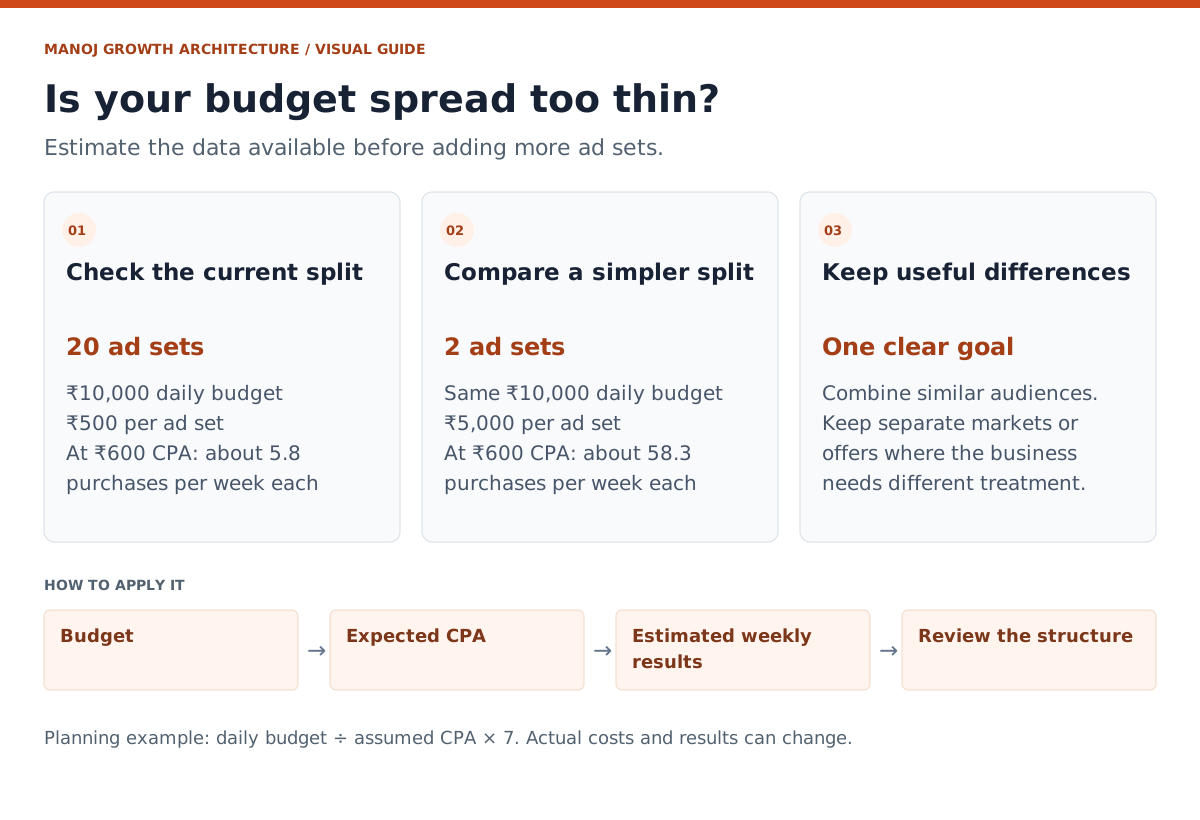
Check the current split
20 ad sets. ₹10,000 daily budget ₹500 per ad set At ₹600 CPA: about 5.8 purchases per week each
Compare a simpler split
2 ad sets. Same ₹10,000 daily budget ₹5,000 per ad set At ₹600 CPA: about 58.3 purchases per week each
Keep useful differences
One clear goal. Combine similar audiences. Keep separate markets or offers where the business needs different treatment.
Planning example: daily budget ÷ assumed CPA × 7. Actual costs and results can change.
A simple budget example
Assume a daily budget of ₹10,000, split equally across 20 ad sets, and an estimated cost per purchase of ₹600.
| Structure | Daily budget per ad set | Estimated purchases per week |
|---|---|---|
| 20 equal ad sets | ₹500 | 5.8 per ad set |
| 2 equal ad sets | ₹5,000 | 58.3 per ad set |
Calculation: daily budget ÷ assumed ₹600 CPA × 7. These are planning estimates, not a forecast. Actual CPA can change when budgets or audiences change.
The example shows how budget concentration changes the amount of data available in each ad set. It does not prove that merging will lower costs or increase total sales.
How to simplify your account
- Group by business goal. Identify ad sets selling the same offer to similar customers.
- Keep necessary differences. Separate markets, languages, offers, or margins when they require different budgets or messages.
- Choose a simpler structure. Combine unnecessary audience splits. Keep creative testing focused on a clear question.
- Check tracking first. Confirm that purchases or qualified leads are recorded correctly before judging performance.
- Record the change. Note the date, budget, creative, and baseline results so you can review the effect.
How much budget is enough?
Start with your expected CPA and the number of conversions you want to observe. For example, ₹600 CPA × 20 purchases ÷ 7 days gives a planning budget of roughly ₹1,715 per day.
Twenty purchases is an example planning choice, not a platform requirement. There is no universal daily-budget multiplier that guarantees stable delivery or a fixed time to leave learning.
What to review after the change
Allow for your normal purchase or lead-to-sale delay. Compare cost per purchase or qualified lead, conversion volume, customer quality, and contribution margin over a meaningful period.
A learning status alone is not a profitability score. Meta and Google use different campaign structures and bidding systems; do not apply Meta ad-set guidance directly to Google Ads.
Before you make changes
- Do these ad sets serve the same goal and offer?
- Is there a business reason to keep them separate?
- Is conversion tracking reliable?
- Have I allowed for delayed conversions?
- Will I measure business results as well as platform metrics?