
Start with the buying problem
If few people search for your product category, search ads alone may not create enough opportunities. Some buyers may recognise the problem without knowing the name of your solution.
Define the customer, the problem, and the reason to act. Use sales conversations and customer questions to shape your message before selecting channels.
Open full-size visual guide ↗
Read the visual guide as text
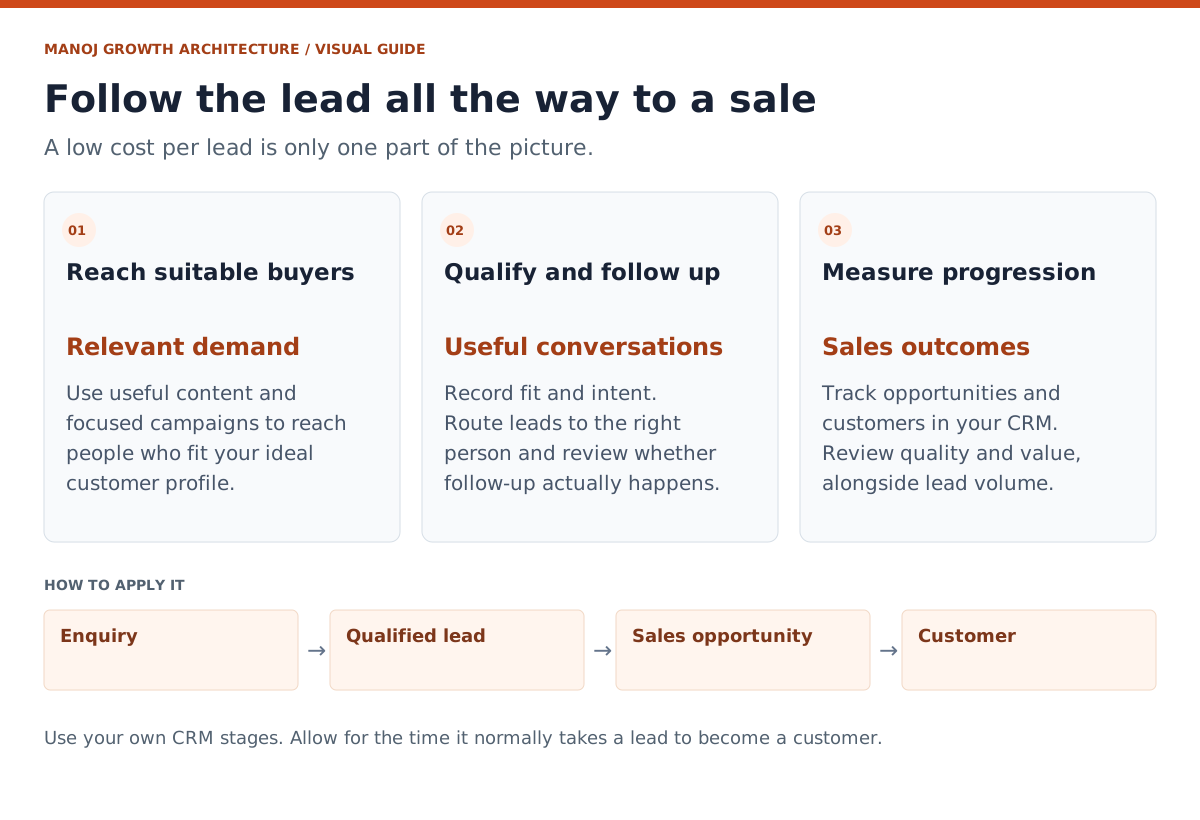
Reach suitable buyers
Relevant demand. Use useful content and focused campaigns to reach people who fit your ideal customer profile.
Qualify and follow up
Useful conversations. Record fit and intent. Route leads to the right person and review whether follow-up actually happens.
Measure progression
Sales outcomes. Track opportunities and customers in your CRM. Review quality and value, alongside lead volume.
Use your own CRM stages. Allow for the time it normally takes a lead to become a customer.
Give each activity a clear job
| Job | Example | What to review |
|---|---|---|
| Create awareness | Founder videos, useful guides, industry examples | Relevant engagement and target-account visits |
| Capture demand | Search ads and focused landing pages | Qualified enquiries and cost per qualified lead |
| Support evaluation | Case studies, demos, and follow-up | Sales opportunities and progression |
Build a focused starting plan
- Choose one customer segment. Describe company size, role, problem, and buying trigger.
- Create one useful offer. A checklist, product walkthrough, or comparison should answer a real buyer question.
- Choose channels your buyers use. Test LinkedIn, Meta, YouTube, or search based on fit and available budget.
- Connect follow-up. Give sales teams the source, offer, and context of each enquiry.
A budget split is a starting hypothesis. Adjust it using lead quality, sales capacity, and the length of your buying cycle.
Measure qualified pipeline
Agree with sales on what makes a qualified lead. Record campaign sources in your CRM and review how leads progress into opportunities and customers.
Review cost per qualified lead, opportunity value, win rate, and time to close. A cheap form submission can be poor value if the person is outside your target market.
Where supported and appropriate, send qualified conversion events back to ad platforms. Check consent, matching, and event quality; connecting a CRM does not guarantee better performance.
Review before increasing spend
- Are the right companies responding?
- Are sales teams following up promptly?
- Which messages lead to useful conversations?
- Have enough leads completed the sales cycle to judge results?