
Find the constraint before adding spend
When growth slows, increasing ad spend may amplify an existing problem. Rising acquisition costs, weak repeat purchases, stock shortages, and poor margins need different responses.
Use your own customer and order data to identify the constraint. ₹1 crore and ₹5 crore are example business stages, not milestones that every brand will follow.
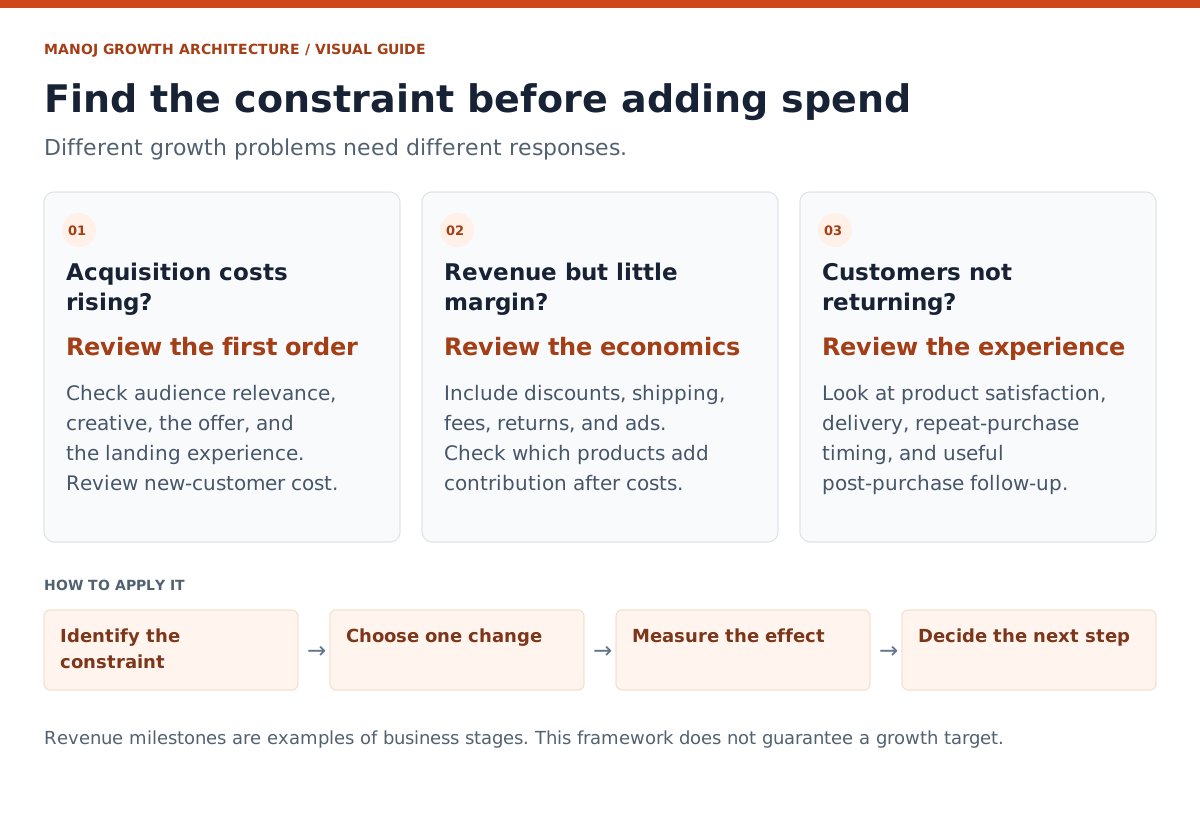
Open full-size visual guide ↗
Read the visual guide as text
Acquisition costs rising?
Review the first order. Check audience relevance, creative, the offer, and the landing experience. Review new-customer cost.
Revenue but little margin?
Review the economics. Include discounts, shipping, fees, returns, and ads. Check which products add contribution after costs.
Customers not returning?
Review the experience. Look at product satisfaction, delivery, repeat-purchase timing, and useful post-purchase follow-up.
Revenue milestones are examples of business stages. This framework does not guarantee a growth target.
Review three connected parts of growth
| Area | Questions to ask | Useful measures |
|---|---|---|
| Acquisition | Are we reaching suitable new customers with a relevant offer? | New-customer cost and first-order contribution |
| Measurement | Can we reconcile ad reports with real orders? | Tracked orders, cancellations, and collected revenue |
| Retention | Do customers have a reason to return? | Repeat purchase rate and customer contribution |
Protect contribution margin
Calculate revenue after discounts, product costs, fulfilment, payment fees, returns, and advertising. Define the costs included so comparisons remain consistent.
A higher ROAS does not always mean higher profit. A lower-margin product, heavy discount, or high return rate can change what you can afford to spend.
Build a focused improvement plan
- Review first-time and returning customers separately.
- Compare product margins and stock availability.
- Test new creative against a clear customer problem.
- Improve the product page and checkout where customers drop off.
- Use relevant, permission-based post-purchase communication.
- Review the effect before expanding the next test.
Scale at a pace the business can support
Increase spend when customer quality, margin, fulfilment, and working capital support the decision. Tracking tools and retention flows can help you operate, but they do not guarantee a revenue milestone.
- Can stock and fulfilment handle more orders?
- Are repeat purchases based on observed behaviour?
- Does the cash collection cycle support the budget?
- Is growth adding contribution after advertising?