
Know what you can afford to acquire
Before setting an ad budget, estimate what remains from an order after product cost, discounts, shipping, payment fees, and expected returns. For COD orders, include return-to-origin costs.
This gives you a starting point for an affordable acquisition cost. Revenue and platform ROAS alone do not show whether a campaign is profitable.
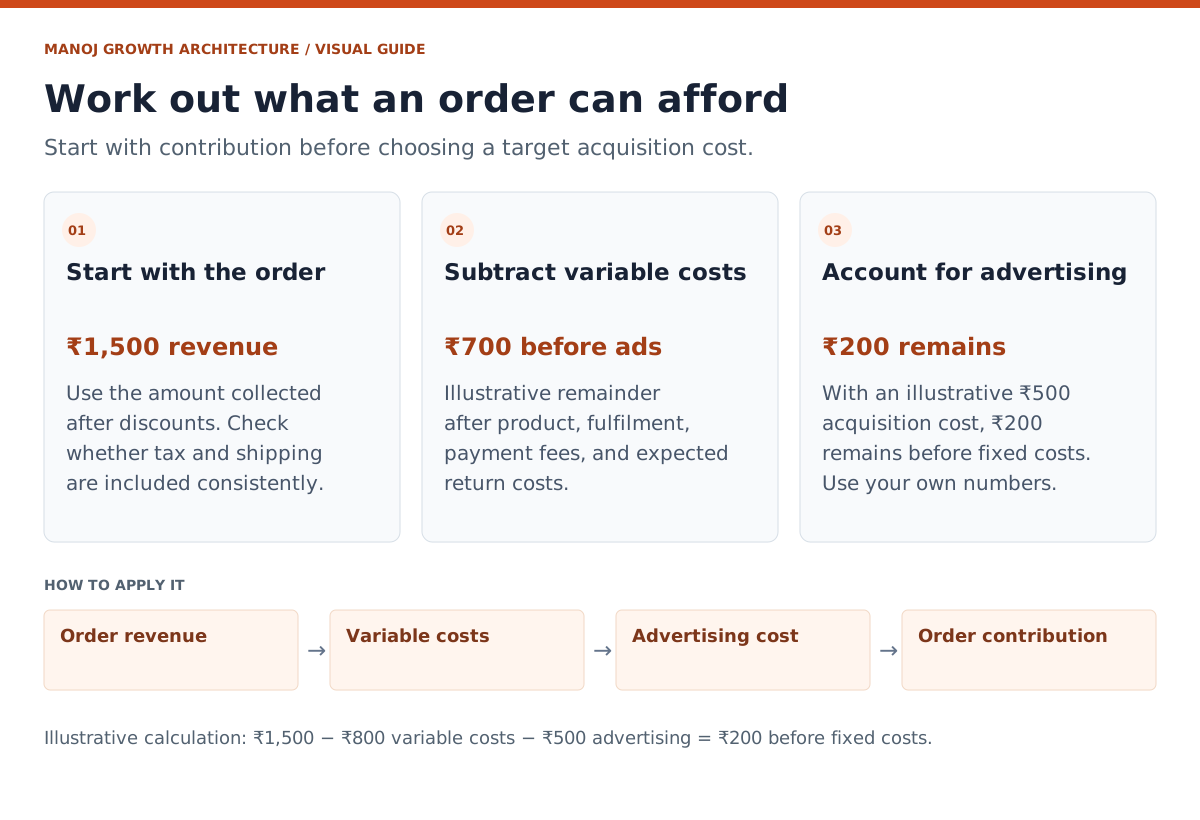
Open full-size visual guide ↗
Read the visual guide as text
Start with the order
₹1,500 revenue. Use the amount collected after discounts. Check whether tax and shipping are included consistently.
Subtract variable costs
₹700 before ads. Illustrative remainder after product, fulfilment, payment fees, and expected return costs.
Account for advertising
₹200 remains. With an illustrative ₹500 acquisition cost, ₹200 remains before fixed costs. Use your own numbers.
Illustrative calculation: ₹1,500 − ₹800 variable costs − ₹500 advertising = ₹200 before fixed costs.
Assign your budget a purpose
| Job | Example activity | Review |
|---|---|---|
| Capture existing demand | Relevant search and shopping campaigns | New-customer cost and margin |
| Introduce the product | Demonstrations, customer stories, and video | Qualified visits and new customers |
| Help shoppers return | Relevant reminders and permission-based follow-up | Incremental orders and repeat purchases |
| Learn what resonates | Focused creative tests | Evidence for the next test |
Prepare the store before scaling
- Check product titles, images, prices, availability, and the shopping feed.
- Make delivery charges, returns, and payment options easy to find.
- Test checkout on a phone.
- Verify purchase tracking and avoid duplicate events.
- Start with products that have sufficient stock and workable margins.
Use numbers as planning assumptions
For an illustrative ₹1,500 order, suppose ₹700 remains after non-ad variable costs. Spending ₹500 to acquire that order leaves ₹200 before fixed costs. If returns or shipping increase, that amount shrinks.
Use your own costs rather than treating a fixed ROAS or budget split as a universal target. Concentrating on a smaller product range can simplify testing, but it will not suit every catalogue.
Review the launch as a business
- Track new-customer cost alongside order contribution.
- Separate booked revenue from collected cash.
- Monitor cancellations, returns, COD RTO, and stock availability.
- Review repeat purchases over a realistic time window.
- Increase budgets when results and working capital support the decision.