
Start with the business goal
Before choosing a platform, define the result you need: purchases, qualified enquiries, booked appointments, or repeat orders. Set a realistic budget using your margins and sales cycle.
A channel is a way to reach customers. Your plan should explain who you want to reach, what you want them to do, and how you will measure it.
Open full-size visual guide ↗
Read the visual guide as text
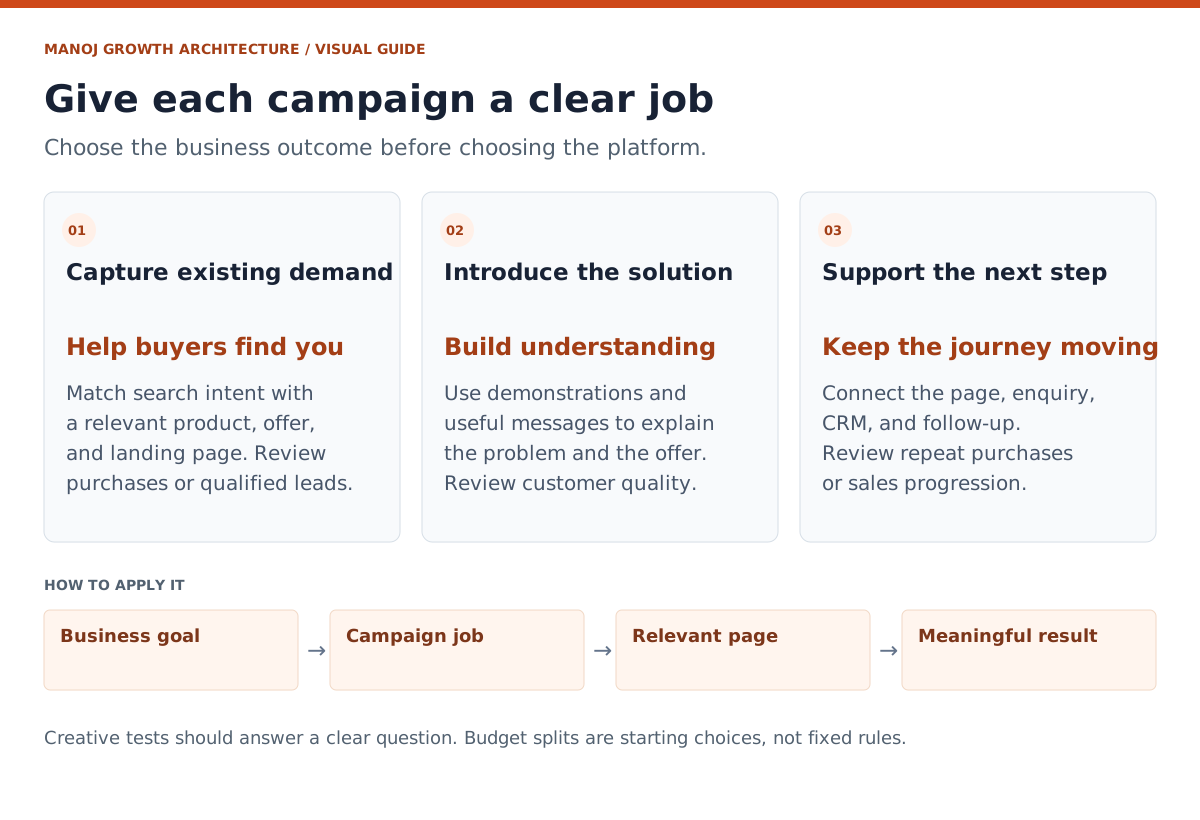
Capture existing demand
Help buyers find you. Match search intent with a relevant product, offer, and landing page. Review purchases or qualified leads.
Introduce the solution
Build understanding. Use demonstrations and useful messages to explain the problem and the offer. Review customer quality.
Support the next step
Keep the journey moving. Connect the page, enquiry, CRM, and follow-up. Review repeat purchases or sales progression.
Creative tests should answer a clear question. Budget splits are starting choices, not fixed rules.
Give each campaign one main job
| Job | Purpose | Example measure |
|---|---|---|
| Capture demand | Reach people already looking for a solution | Cost per purchase or qualified enquiry |
| Create demand | Introduce a useful solution to potential buyers | New-customer response and assisted pipeline |
| Support repeat business | Help existing customers buy again | Repeat purchase contribution |
| Test creative | Learn which messages and formats resonate | Results against a defined test question |
Set up useful measurement
Check that your website and CRM record the outcomes you care about. Use platform conversion tools where appropriate, with consent and privacy settings suited to your business.
Server-side tracking can support measurement, but it does not recover every missing conversion or guarantee complete attribution. Compare platform reports with orders, qualified leads, and collected revenue.
Keep the first test manageable
- Choose a small number of campaigns with distinct goals.
- Create a few genuinely different messages, such as a demonstration, customer problem, or product comparison.
- Match each ad to a relevant landing page.
- Record your budget, expected cost per result, and review window.
- Allow for conversion delays before making repeated changes.
Decide what to change next
If clicks are relevant but sales are weak, inspect the offer, landing page, and checkout. If leads are cheap but unqualified, review the message, targeting, and qualification process.
Budget allocations are testable choices, not fixed rules. Scale when business results support it, and reserve enough cash to learn without putting operations under pressure.
A short launch checklist
- One clear business goal per campaign.
- Reliable conversion tracking.
- A useful offer and matching landing page.
- A budget informed by margins.
- A review window that reflects the buying cycle.