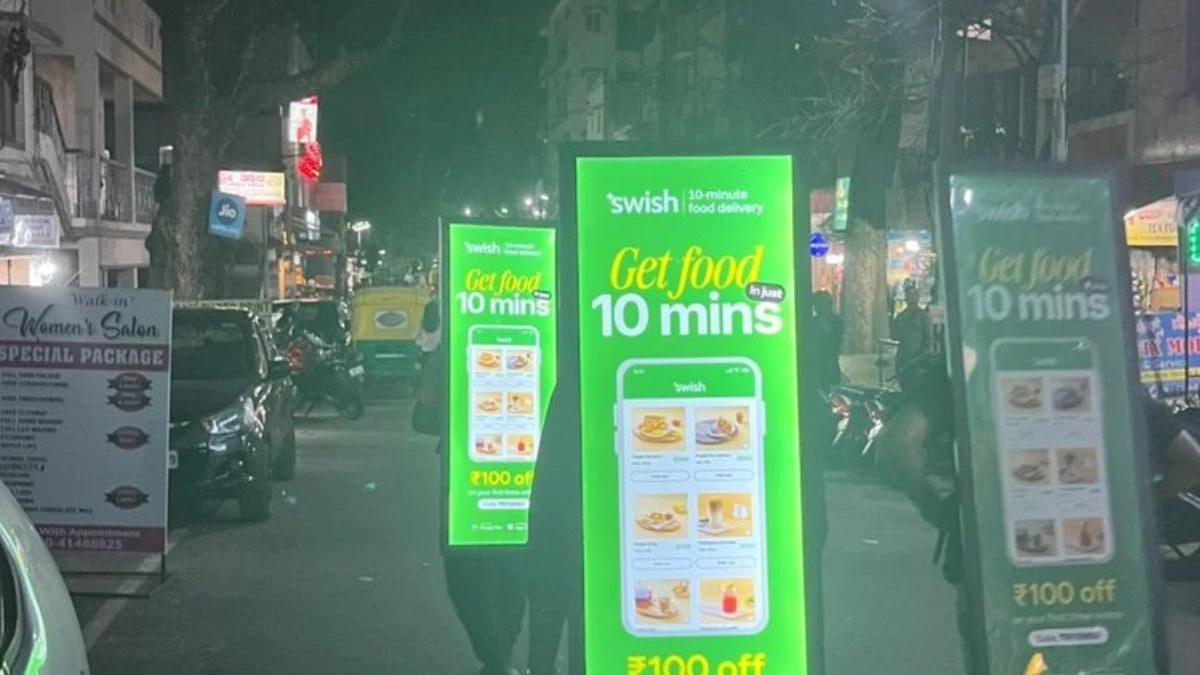
“Get food in 10 mins.” “₹100 off.”
The Swish boards in this photograph communicate a straightforward offer. But the detail that stays with me is the people carrying those illuminated advertisements through the street.
My question is about the spending decision behind this execution: could the money have gone toward helping nearby customers discover the service through local digital advertising, instead of putting an advertising board on someone’s back?
For me, that should be the starting point of the campaign review. The objective is to reach potential customers. Requiring a person to carry the message is a choice about how to do it.
1. The offer is already clear. The next decision is how to distribute it.
The creative gives us a brand, a speed promise, food imagery, and a discount. The “10 mins” text is a promise in the advertisement; this photograph cannot verify delivery performance or its conditions.
Once the message is ready, the marketing question becomes: where should the business pay to place it?
A wearable board is one answer. Local digital advertising, discovery-focused creative, and placements with neighbourhood businesses are other answers. Each should be judged against the same objective: helping suitable people nearby find the service and take a useful next step.
A clear offer is also different from a clear call to action. The viewer still needs an easy way to find the app, check availability, and order. Smaller instructions are difficult to assess in this photograph.
2. I would put local discovery on the table first
For a neighbourhood delivery service, the useful audience is people who can actually order. My preference would be to test the budget against that audience through local digital placements before choosing a format that people have to carry.
That could mean simple food-led creative introducing the service to nearby audiences, or advertising that helps people already looking for a meal discover the business. Here, “discovery” describes the job of introducing the brand; it is not a claim about a particular advertising platform’s campaign type.
Keep the message connected to the neighbourhood
The creative could explain what someone can order, show the offer clearly, and lead to an availability check. Geographic settings would need to be reviewed against actual delivery coverage; targeting an area does not guarantee that every person reached is serviceable.
Make the route to ordering easier to evaluate
A digital placement can provide a direct next step. The business can then examine what happens after the click: whether the visitor checks availability, begins an order, and completes it. Those signals do not automatically establish additional sales, but they can help identify where the journey loses people.
The argument is not that a digital ad will always outperform a street board. It is that a less physically demanding way of reaching the same audience deserves serious consideration before assigning people a load to carry.
3. Physical effort belongs in the budget decision
Campaign budgets usually show production, staffing, placements, and customer acquisition costs. The person’s physical experience deserves attention alongside those numbers.
The photograph does not tell us the boards’ weight, how they are supported, how long they are carried, or whether these workers experience pain. We should not invent those details.
But the format does raise questions about shoulder pressure, neck or back discomfort, fatigue from walking or standing, freedom of movement, and opportunities to remove the board and rest. Those questions should be answered by inspecting the setup and listening to the people doing the work.
Why choose an execution that requires someone to carry equipment if a practical alternative can deliver a comparable business outcome with less physical demand?
That is the decision I want this photograph to prompt. A bright, unusual execution should not allow the physical experience of carrying it to disappear from the discussion.
4. Attention alone does not justify the format
The boards stand out in the night scene. Movement and illumination may attract attention. That is a plausible benefit, but the image cannot tell us how many people noticed, remembered the brand, or ordered.
Even a highly noticeable advertisement has a longer journey to complete:
Notice → understand → find the service → check availability → place an order → return.
A glance is not a purchase. A photograph shared online is not proof of profitable acquisition. Before calling the execution successful, I would want evidence of the outcome it was commissioned to produce.
The same standard applies to digital advertising. Cheap impressions and clicks are insufficient if they do not translate into useful customers.
5. Compare the same budget against the same business goal
I would ask the team to build two practical proposals: the wearable-board activity and a local digital discovery test. Both should state the audience, service area, offer, duration, full cost, and desired outcome.
Count every relevant cost
For the street activity, include staffing, equipment, transport, supervision, charging, and maintenance. For digital advertising, include media, creative production, setup, and management. Include promotional subsidies consistently in both options.
Measure beyond the first response
Review fulfilled first orders, contribution after relevant costs, and repeat behaviour. A dedicated code or link can identify some responses, but codes can be shared and people can discover the brand through multiple channels.
Look for additional business
Where practical, plan comparisons across reasonably similar areas or periods. Account for other promotions, delivery capacity, and changes in demand. Attributed orders should not automatically be treated as orders the business would otherwise have lost.
Local digital advertising may cost more per customer, less, or produce no useful lift. The point is to test the alternative rather than assume that making people carry the message is necessary.
6. Changing the format should include the people doing the work
Questioning wearable boards should not mean dismissing the workers or treating their income as irrelevant. If a business changes the activity, it should consider whether those staff can move into less physically demanding promotional roles.
A staffed local information point, merchant outreach, or another suitable task may be worth considering, depending on the business and the workers’ preferences. The people affected should have a voice in that discussion.
The question is about the employer’s campaign design and spending choices. The workers carrying out the assignment are not responsible for justifying the format.
Spend to help people discover the brand. Question the need to carry it.
My preference is to explore local digital and discovery advertising before spending on a format that places a physical load on people.
That preference still needs commercial testing. This photograph does not establish that the boards caused harm, that the campaign failed, or that another channel would certainly perform better.
But we do not need those conclusions to ask a reasonable question: can the same budget reach nearby customers effectively without asking someone to carry an illuminated advertisement through the street?
If a less physically demanding approach achieves a comparable result at a reasonable cost, I would choose it. That is a campaign design decision worth making deliberately.
A question for your next campaign review
Before approving an attention-grabbing execution, ask: what are we paying to achieve, what does it ask of the people delivering it, and could we achieve it with less physical burden?