
Price is one part of the decision
A lower messaging cost may attract attention, but businesses also consider where their customers are, whether messages are reliable, and how the product fits their daily work.
This article explores product strategy. It does not predict a platform winner or compare current API prices.
Open full-size visual guide ↗
Read the visual guide as text
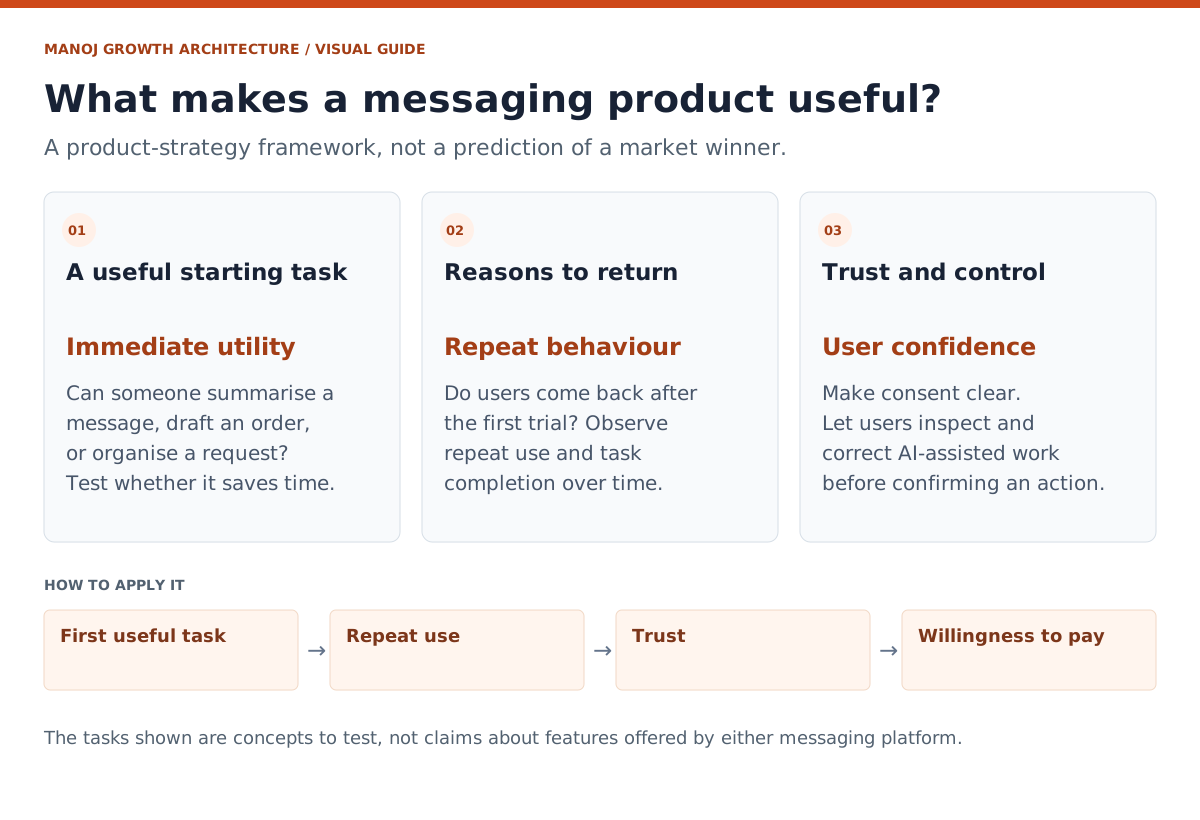
A useful starting task
Immediate utility. Can someone summarise a message, draft an order, or organise a request? Test whether it saves time.
Reasons to return
Repeat behaviour. Do users come back after the first trial? Observe repeat use and task completion over time.
Trust and control
User confidence. Make consent clear. Let users inspect and correct AI-assisted work before confirming an action.
The tasks shown are concepts to test, not claims about features offered by either messaging platform.
Understand the switching problem
Messaging products depend on connections between people. A useful feature is harder to adopt if customers, colleagues, or suppliers must move at the same time.
For a new service, the question is practical: what useful job can someone complete before their entire network joins?
Explore a useful starting point
| Possible job | Hypothesis | What to test |
|---|---|---|
| Summarise a voice note | Busy users may value a short written summary | Accuracy, language support, and repeat use |
| Prepare an order draft | A voice message could reduce manual entry | Corrections, user confirmation, and time saved |
| Organise customer requests | A simple queue could help small teams follow up | Completion rate and daily usage |
These are concepts to validate, not claims about features available in either product.
Build trust into the experience
People need control over contact permissions, business messages, and data use. Clear consent, understandable privacy settings, and ways to report unwanted messages are part of the product experience.
For AI-assisted tasks, let users inspect and correct outputs before sending a message or confirming an order.
Measure usefulness before predicting scale
- Can a new user complete a useful task?
- Do users return without repeated incentives?
- Does the product save measurable time?
- Will businesses pay after a trial?
- Can support and reliability keep up with adoption?
Strong answers can support the next product decision. They do not guarantee adoption, market share, or commercial success.