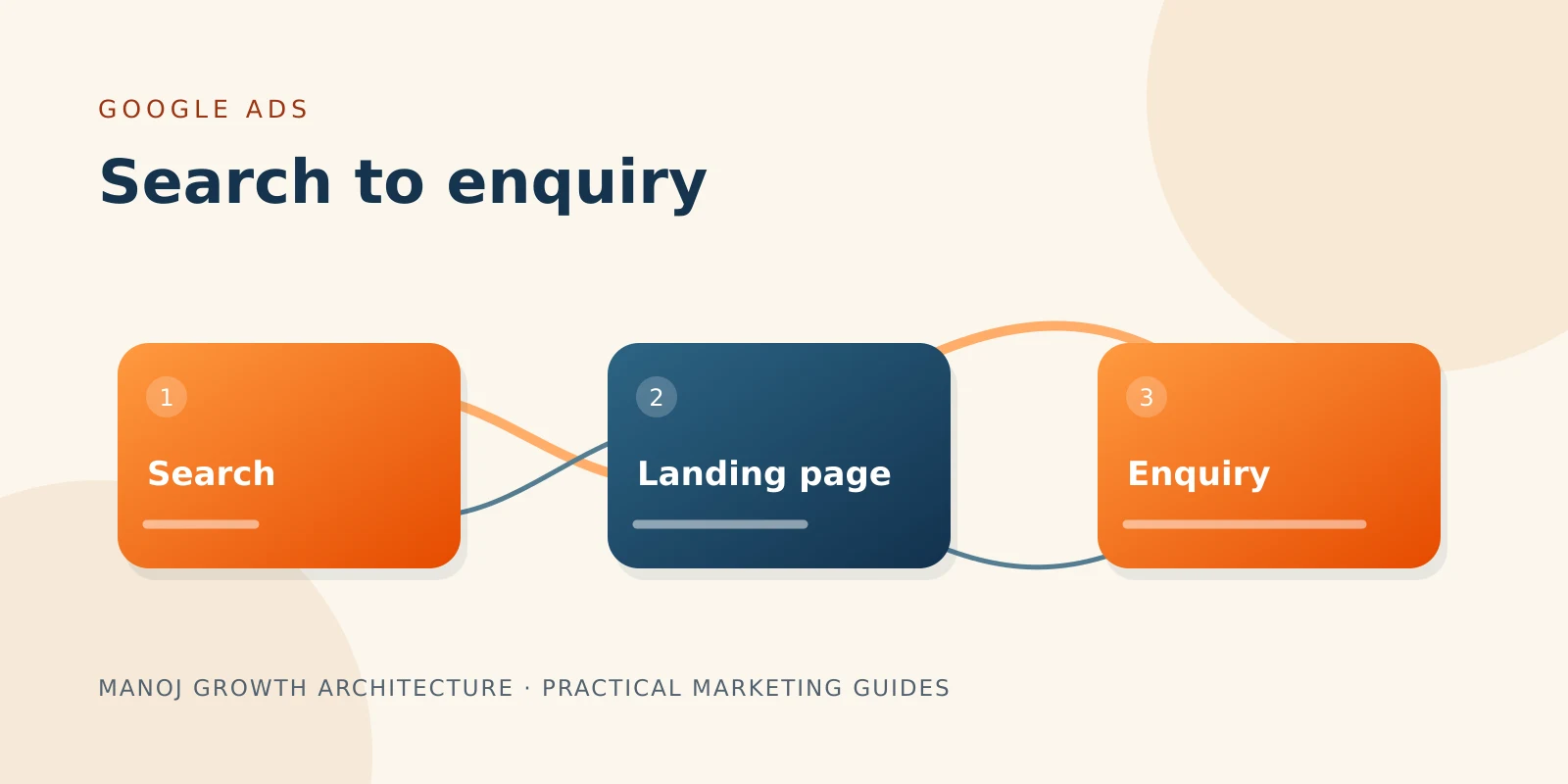
Clicks show that people reached an ad. They do not tell you whether those people wanted your service, understood your offer, or could complete the enquiry process.
When a Google Search campaign spends without producing enquiries, start with relevance and the route to conversion.
Look at what people actually searched
Review the search terms report, rather than judging relevance from your keyword list alone. Google describes this report as a way to inspect the searches that triggered your ads; some queries are omitted for privacy. Google Ads: search terms report
Group visible queries into suitable buying intent, research, and unrelated intent. A business selling accounting software may attract people looking for accounting jobs or free templates. Those visits need different treatment from someone comparing paid software.
Exclude clearly unsuitable searches carefully. Do not remove a relevant query just because a handful of clicks has not converted.
Check whether enquiries can be recorded
Submit the form yourself on a phone. Check that the confirmation appears and the enquiry reaches your inbox or CRM. Test any advertised call or booking route too.
Then inspect your conversion setup. A page visit and a completed enquiry represent different outcomes. Make sure the campaign's reported success matches the action the business needs.
Match the page to the search
Someone searching for commercial office cleaning should immediately see that service, its coverage area, and how to request a quote.
A general homepage asking visitors to find the service themselves creates extra work. Use a relevant page with a clear offer, credible evidence, and an obvious next step.
Find friction before buying more traffic
Check mobile loading, form errors, unclear required fields, and whether the contact button works. Compare performance by device and landing page where you have enough data.
Read the funnel in stages
Separate the journey into impression, click, loaded page, enquiry, qualified enquiry, and customer. A problem at one stage does not automatically call for a change at another.
| Symptom | First investigation |
|---|---|
| Spend comes from unrelated searches | Query relevance and exclusions |
| Clicks arrive but the page fails to load reliably | Mobile performance and destination errors |
| Relevant visitors read but do not enquire | Offer clarity, trust, and contact friction |
| Enquiries arrive but reports show none | Measurement and conversion implementation |
| Reports show conversions but sales sees little value | Conversion definitions and lead qualification |
Check more than one signal. For example, a low enquiry rate could reflect research traffic, a weak offer, or a broken form. You need evidence before choosing the fix.
Build an intent-to-page match
Consider a company advertising office cleaning in Chennai. “Office cleaning quotation” suggests a different need from “office cleaning checklist.” A quotation page might explain coverage, service frequency, and how to book an assessment. A checklist visitor may be gathering information or planning to do the work internally.
Use the distinction to decide which searches belong in the acquisition campaign. If a research query has a role in your strategy, give it an appropriate resource and measure it accordingly. Do not judge every information-seeking visit as though it requested a quote.
Make the service and location clear in the ad too. Avoid attracting a broad set of visitors with a vague promise and trying to qualify them only after they click.
Know whether your cost per click is workable
Suppose, for illustration, a click costs ₹100 and 5% of visits become enquiries. Twenty clicks cost ₹2,000 and produce one enquiry on average under those assumptions.
If one in five enquiries becomes a customer, the implied acquisition cost is ₹10,000. That might work for a valuable recurring contract and be unaffordable for a small one-off job.
The calculation is a planning model, not a forecast. It helps identify what needs to improve: click cost, enquiry rate, lead quality, close rate, or the economics of the offer. Changing bids alone cannot compensate for an offer with insufficient margin.
Avoid misleading conversion goals
Review the events included in your campaign's conversion goals. A contact-page view, a button click, and a submitted form should not be interpreted as the same business result. Keep useful diagnostic events, but make their meaning clear.
For businesses that close sales later, consider a supported offline conversion or enhanced-conversions-for-leads implementation. These can connect later outcomes to advertising; they require correct implementation and appropriate handling of customer data. They do not replace a consistent qualification process. Google: offline conversion guidance
Decide what to change this week
Start with a broken buying route or clearly irrelevant spend, because you can establish those problems directly. Next, improve the match between the search, ad, and page. Then assess whether the offer is competitive and credible.
Record a baseline and keep a change log. If you rewrite the page, replace keywords, alter bids, and change conversion goals together, any result becomes harder to explain.
Avoid applying a universal rule such as “pause after ten clicks.” A relevant search for a high-value service can need a different evidence threshold from an inexpensive product. Set limits from your economics and available budget, while allowing for conversion delay.
A final page check
- Can a visitor identify the service immediately?
- Are coverage, eligibility, and important pricing conditions clear?
- Is there credible evidence supporting the offer?
- Does the mobile form work and reach the business?
- Does measurement distinguish a visit from a genuine enquiry?
Try this next: inspect the searches responsible for the most spend, test the enquiry journey, and fix the clearest mismatch first. Review enquiries and qualification over a period that reflects your buying cycle before increasing the budget.