Platform information checked: 27 October 2026.
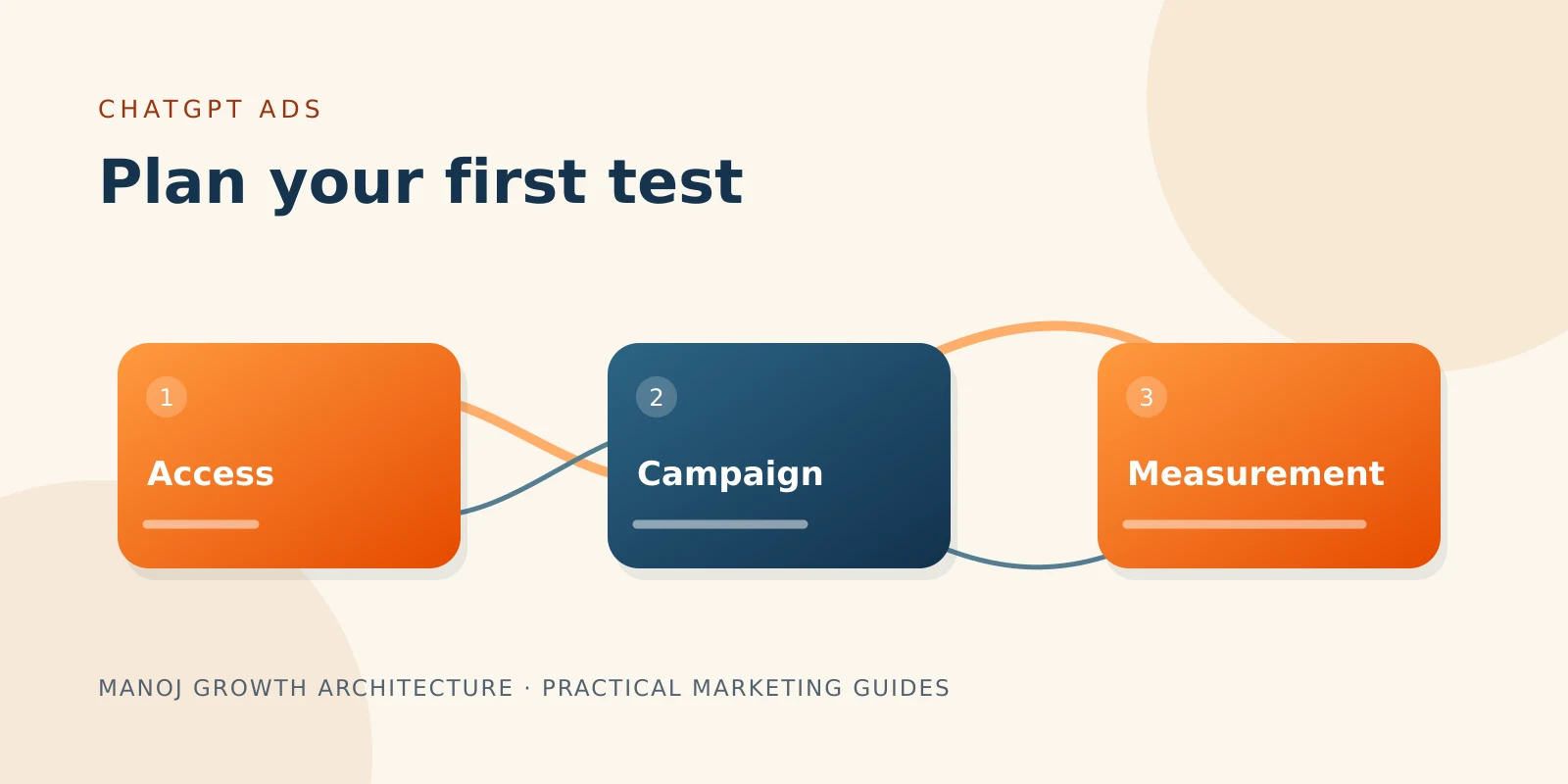
Before testing a new advertising channel, answer three questions: can your business access it, what customer action do you want, and how will you judge the result?
OpenAI's official Ads documentation provides an advertiser signup route and describes a measurement pixel, Conversions API, and Advertiser API. These support advertising measurement and programmatic campaign work. OpenAI Ads overview
Start with advertiser access
Follow the signup link from the official Ads overview. Confirm the current onboarding requirements, supported market, business eligibility, and options available to your account.
The documentation alone does not establish that every advertiser or country has access. Check those details before committing money or promising a launch date.
Prepare one clear offer
Choose a product or service with a specific use case and a page that explains it well. Decide whether success means a purchase, qualified enquiry, booking, or another measurable action.
For example, a booking-software business could build its first test around appointment scheduling for small clinics. That gives the campaign a more focused message than a broad promise to improve every business process. This is a planning example, not a targeting guarantee.
Build within the options your account supports
Prepare advertiser details, ad assets, the destination page, and a test budget. Use the campaign formats, targeting controls, and submission process currently provided to you.
For an API implementation, follow OpenAI's account and campaign documentation rather than assuming another platform's setup applies. API partner setup · Campaign management
Follow the documented campaign sequence
For advertisers implementing through the API, OpenAI documents this order: confirm the ad account and brand approval, configure the conversion resources you need, create a campaign, add its ad groups, then add ads. Keep resources paused while completing setup and checking the destination.
The campaign holds the objective and budget; ad groups hold bidding configuration and context hints. An active ad also depends on the parent resources being eligible and active. Conversion optimization requires an eligible conversion event and access enabled for the account. This is an API workflow; use the current onboarding instructions for any account interface you are offered. OpenAI: campaign management · OpenAI: account setup
Set up measurement before spending
Choose the outcome to record and use the supported measurement integration appropriate to your implementation. Test the event, check for duplicate reporting, and confirm that real orders or enquiries reach your business systems.
Use campaign links that help identify visits in your own analytics. For lead generation, record qualification and customer outcomes too.
Run a focused first test
Set an affordable spending limit, keep the offer consistent, and record what you changed. Review available delivery and conversion reports alongside actual business outcomes. Consult the current budget controls before launch. OpenAI: bidding and budgets
Build a launch brief before opening campaign controls
A first campaign should answer a specific business question. “Can this channel generate qualified appointment-software enquiries at an affordable cost?” gives you a clearer test than “Let's try AI advertising.”
Write down the customer, use case, offer, destination, success event, and spending limit. Include what would make you pause, continue, or expand the experiment. These are your business decisions, not universal platform benchmarks.
Do not assume search keywords, social audiences, or placement choices from another platform exist in the same form here. Use the controls and policies actually available to your advertiser account.
Prepare a page that helps someone evaluate the offer
The destination should explain who the product is for, what problem it solves, and the next step. Include important conditions such as pricing structure, availability, compatibility, or service coverage where relevant.
For appointment software, a focused page could explain clinic scheduling, show the booking process, answer integration questions, and offer a relevant demonstration. Sending every campaign to a broad homepage can make it harder to connect the ad promise with a useful action.
Check the page on a phone and complete the buying or enquiry journey yourself. Confirm that the business actually receives the submission before using it as the campaign's success event.
Separate ad activity from business outcomes
Build a small reporting table before launch:
| Layer | What to inspect | Why it matters |
|---|---|---|
| Delivery | Available spend and delivery reporting | Whether the campaign is serving |
| Visits | Identified campaign visits in your analytics | Whether the destination is receiving usable traffic |
| Actions | Tested purchase, booking, or enquiry events | Whether visitors complete the intended step |
| Quality | Qualified enquiries or valid orders | Whether reported actions have business value |
| Economics | Customer acquisition cost and contribution | Whether the channel is affordable |
Use consistent definitions when comparing these layers. An analytics visit and a platform-reported click need not match exactly. Check event setup, reporting windows, and definitions before treating every discrepancy as lost traffic.
Plan the measurement implementation
Decide who owns the website event setup, consent handling, and business reporting. Keep a record of the success event and what causes it to fire. A purchase should be associated with a completed order, rather than a simple visit to a product page.
If browser and backend measurement are both used, follow the current integration guidance for identifying and handling duplicate events. Inspect test activity and production reporting before relying on the numbers for budget decisions.
The practical aim is a traceable route from campaign activity to a real business action. Installing tracking alone does not establish accurate attribution or prove that an ad caused a sale.
Use a budget based on an acceptable outcome
Suppose a business can afford ₹3,000 per qualified enquiry and allocates ₹15,000 to an initial experiment. Five qualified enquiries would meet that arithmetic target, but such a small result would still leave substantial uncertainty about repeatability.
If the campaign produces ten submissions and only one is suitable, the qualified-enquiry cost is ₹15,000, regardless of the attractive ₹1,500 raw cost per submission. Review the offer and qualification before treating the experiment as a success.
These are hypothetical numbers to explain planning. They are not estimates of ChatGPT advertising prices, minimum budgets, or expected results.
Decide what the first test has taught you
If delivery is limited, investigate eligibility, approvals, and configuration through the current platform guidance. If visits arrive without meaningful actions, inspect the offer and destination. If actions are recorded but lack quality, investigate the message, qualification, and expectations.
When useful customers appear, confirm that the measurement and economics hold across a larger review window before committing materially more budget. Document what you learned so the next campaign tests a clearer question.
Questions before launch
- Is advertiser access confirmed for this business and market?
- Have current policies and account-specific controls been checked?
- Does the page deliver on the ad's promise?
- Has the success event been tested end to end?
- Are spending limits and a review date recorded?
- Is someone responsible for checking customer quality?
Advertiser interfaces and account access can change. Use the current official documentation and the options enabled in your account when implementing these steps.
Try this next: confirm access, prepare one offer and destination page, test measurement, then launch a limited experiment. Judge whether the channel produces useful customers at workable economics before expanding it.