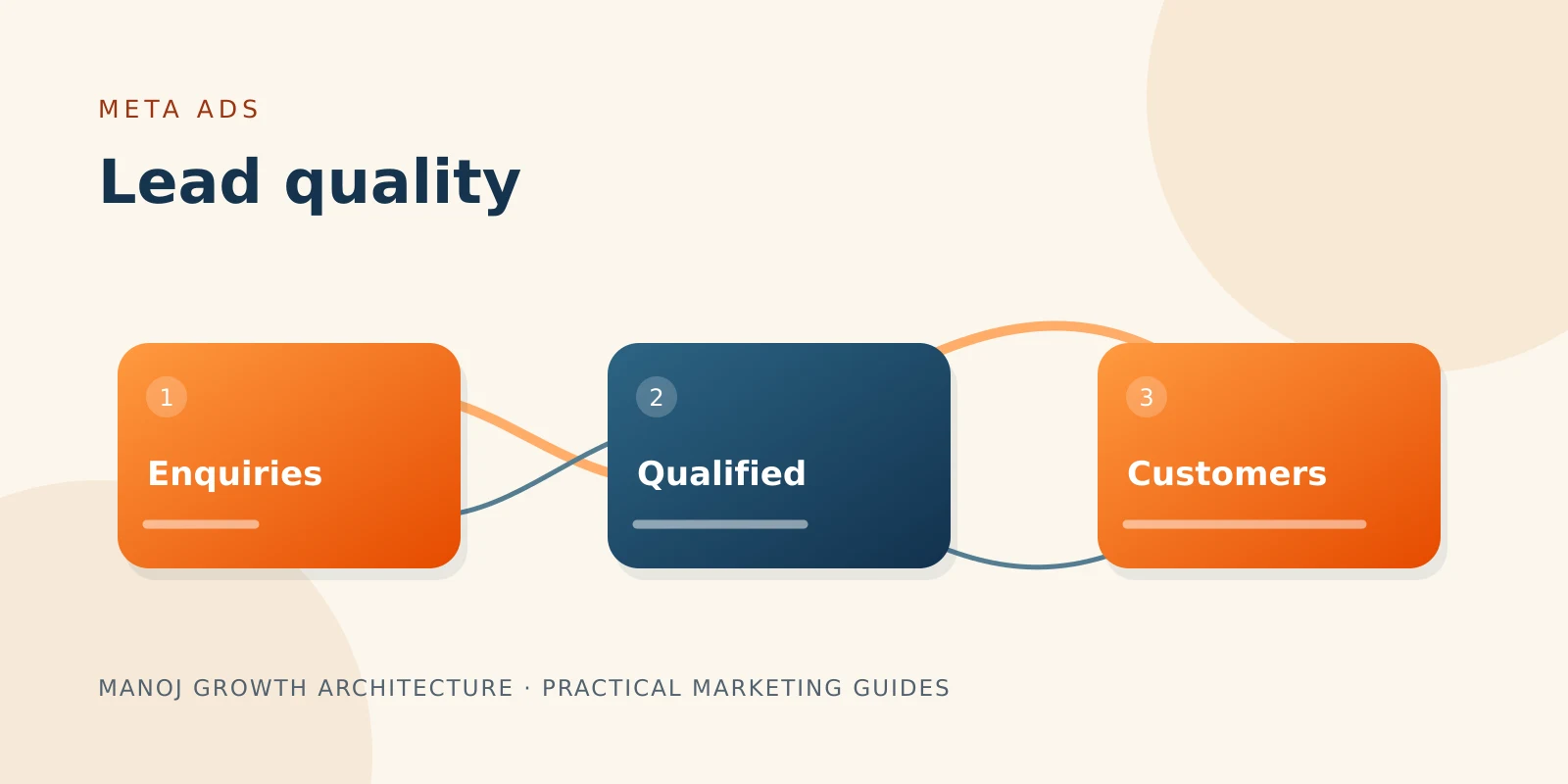
Your campaign is generating enquiries. The cost per lead looks reasonable. But the sales team says people do not answer, cannot afford the service, or do not remember submitting the form.
Before replacing the campaign, find where the lead journey breaks.
Give “bad leads” a specific meaning
Review a recent batch with sales. Classify each enquiry as unreachable, outside your service area, unsuitable, interested later, or ready for a conversation. Record when the lead arrived and when someone first responded.
These categories need different fixes. A buyer outside your service area suggests a relevance problem. A suitable buyer who waited days for a reply suggests a follow-up problem.
Check the promise in your ad
Read the ad as someone seeing your business for the first time. Does it explain what you sell, who it suits, and what happens after submitting?
An ad promising a free guide can attract people who want information. Calling everyone immediately to sell an expensive service introduces a different expectation.
Align the ad, form, confirmation message, and first conversation around the same next step.
Make qualification useful
Ask a question that helps route or assess the enquiry: required service, location, buying timeframe, or company size. Use a price range where that would help someone judge suitability.
Avoid adding questions simply to make the form longer. Each question should support a decision. Test whether it improves qualified enquiries enough to justify any reduction in submissions.
Review what happens after submission
Confirm that enquiries reach the right person. Give that person the ad and offer context. Tell the prospect how and when you will contact them, then follow through.
Track contacted leads, qualified conversations, appointments, and customers alongside raw submissions.
Work through a lead-quality example
Imagine two campaigns, each spending ₹15,000. Campaign A produces 100 enquiries at ₹150 each. Campaign B produces 50 at ₹300 each. Looking only at cost per lead makes A appear stronger.
Now suppose A produces 10 qualified conversations while B produces 20. Their costs per qualified conversation are ₹1,500 and ₹750 respectively. B has fewer submissions but gives sales more suitable conversations for the same spend.
This is an illustrative comparison. It shows why you should follow the funnel rather than assuming the cheapest submission represents the best acquisition opportunity. Continue tracking customers and contribution: a qualified conversation is still an intermediate result.
Use a diagnosis table before editing the campaign
| What you observe | What to investigate | A focused next action |
|---|---|---|
| People deny making an enquiry | Accidental submissions, unclear promise, contact accuracy | Review the form journey and make the requested action explicit |
| Enquiries come from unsuitable buyers | Message, service area, qualification | State the audience and essential requirements earlier |
| Suitable prospects are hard to contact | Response timing, contact route, delivery failures | Audit routing and agree on a follow-up process |
| Conversations happen but appointments do not | Offer, price expectations, next-step clarity | Review call notes and common objections |
| Appointments happen but customers do not buy | Product fit, sales process, decision timing | Review the sales stage before changing acquisition |
Treat these as investigation prompts. An unanswered call alone does not prove that someone was an unsuitable prospect.
Should you use an instant form or a website form?
Choose based on what the buyer needs to understand before enquiring. A straightforward appointment request may need little explanation. A complex service may benefit from a page that explains eligibility, process, and pricing before submission.
An instant form reduces the steps between an ad and an enquiry. A website gives you more room for explanation but adds a page load and another journey to maintain. Neither format automatically produces better customers.
If comparing them, keep the offer and qualification criteria consistent. Review the cost per qualified conversation and downstream results, rather than comparing submissions alone.
Meta's lead-generation guidance describes instant forms, website forms, CRM integrations, and conversion-leads optimization. Where available and appropriate, returning qualified outcomes through the supported CRM integration can connect campaign measurement with later sales stages. Confirm current requirements in your account. Meta: lead-generation guide
Run a test you can learn from
Write the hypothesis before making changes: “People enquire without understanding the service price, so adding a starting price may improve qualification.”
Record the original submission rate, qualification rate, and cost per qualified conversation. Change the price explanation without simultaneously replacing the audience, offer, and follow-up script. Keep a note of any unavoidable changes.
The result may be fewer forms and more useful conversations, or fewer forms without an improvement in quality. Both teach you something. Choose a review window that allows enquiries to receive follow-up and reflect the normal buying process.
Questions to ask before increasing spend
- Can the sales team explain why prospects are unsuitable?
- Does the ad describe the same offer that sales presents?
- Are leads delivered and followed up reliably?
- Are qualified outcomes linked back to their source?
- Can the team handle more enquiries without slowing its response?
Improve the weakest part of that journey before buying a larger volume of the same leads.
Try this next: review your latest 20 enquiries as a diagnostic sample. Identify the most common reason they stalled, change the part responsible, and compare the next group after allowing time for follow-up. Twenty is a starting sample, not a statistical threshold.